Carbon Upcycling secures $10M in financing from ATEL Ventures to support clean cement manufacturing
Under the agreement, the financing is secured by Carbon Upcycling’s assets, and ATEL receives an option to make a future investment in the company.



Lorem ipsum dolor sit amet, consectetuer adipiscing elit. Aenean commodo ligula eget dolor. Aenean massa. Cum sociis Theme natoque penatibus et magnis dis parturient montes, nascetur.

Lorem ipsum dolor sit amet, consectetuer adipiscing elit. Aenean commodo ligula eget dolor. Aenean massa. Cum sociis Theme natoque penatibus et magnis dis parturient montes, nascetur.
Ultricies nisi. Nam eget dui. Etiam rhoncus. Maecenas tempus, tellus eget rhoncus, amet sem vel quam nunc semper libero, sit amet sem neque sed ipsum. Namet quam nunc. Lorem ipsum.
Ultricies nisi. Nam eget dui. Etiam rhoncus. Maecenas tempus, tellus eget rhoncus, amet sem vel quam nunc semper libero, sit amet sem neque sed ipsum. Namet quam nunc. Lorem ipsum.
Ultricies nisi. Nam eget dui. Etiam rhoncus. Maecenas tempus, tellus eget rhoncus, amet sem vel quam nunc semper libero, sit amet sem neque sed ipsum. Namet quam nunc. Lorem ipsum.
Each year, billions of tonnes of low-grade Coal Combustion Products (CCPs) are shipped to landfills or tailings ponds across North America. Our innovative technology not only prevents these CCPs from going to waste but enhances them to meet or exceed current
market fly ash with improved reactivity and durability.
We’ve upcycled over 3 billion tonnes of Coal Combustion Products to date.
Coal Combustion Products we currently work with:
 Harvested Class C Harvested Class FBottom ash
The world is rapidly shifting towards cleaner steel production techniques, such as electric arc furnaces. Until recently, the slags generated from this process could only be utilized as aggregate. With our technology, we can reduce shrinkage, and heavy metal leaking while improving reactivity and durability.
We’ve upcycled over 3 billion tonnes of Coal Combustion Products to date.
Slags we currently work with:
Basic Oxygen Furnace slagElectric Arc Furnace slag
While calcined clays have rapidly become a popular supplementary cementitious material (SCM), their usage is limited by the availability of suitable clays and the high energy required for treatment. Carbon upcycling can activate all types of clays with significantly less energy than calcination, resulting in reduced water and energy demand, enhanced reactivity and durability, and greater availability.
We’ve upcycled over 100 billion gigatons of clays to date.
Clays we currently work with:
Low-kaolin (<30%)High-kaolin (>30%)Shale
Lorem ipsum dolor sit amet, consectetur adipiscing elit.
Proin nec risus magna.
Lorem ipsum dolor sit amet, consectetur adipiscing elit.
Proin nec risus magna.
Ultricies nisi. Nam eget dui.
Ultricies nisi. Nam eget dui.
Ultricies nisi. Nam eget dui.
Ultricies nisi. Nam eget dui.
Ultricies nisi. Nam eget dui.
Under the agreement, the financing is secured by Carbon Upcycling’s assets, and ATEL receives an option to make a future investment in the company.
We will work with Holcim and Amazon to test, validate, and scale our low-carbon supplementary cementitious materials (SCMs) in real-world applications.
Since joining Carbon Upcycling in spring 2025 as Chief Revenue Officer, Markus has led the development of the company’s project pipeline and guided the company as it constructs i
Carbon Upcycling Technologies transforms CO2 and industrial byproducts into low-carbon cement replacements — a circular solution for hard-to-abate industries.
Lorem ipsum dolor sit amet messa. Con secte tuer adi pisc ng elit. Aenean com modo ligul.
Lorem ipsum dolor sit amet messa. Con secte tuer adi pisc ng elit. Aenean com modo ligul.
Lorem ipsum dolor sit amet messa. Con secte tuer adi pisc ng elit. Aenean com modo ligul.
Lorem ipsum dolor sit amet messa. Con secte tuer adi pisc ng elit. Aenean com modo ligul.








Lorem ipsum dolor sit amet, consectetur adipiscing elit. Ut elit tellus, luctus nec ullamcorper mattis, pulvinar dapibus leo.
Lorem ipsum dolor sit amet, consectetur adipiscing elit. Ut elit tellus, luctus nec ullamcorper mattis, pulvinar dapibus leo.
Lorem ipsum dolor sit amet, consectetur adipiscing elit. Ut elit tellus, luctus nec ullamcorper mattis, pulvinar dapibus leo.
Lorem ipsum dolor sit amet, consectetur adipiscing elit. Ut elit tellus, luctus nec ullamcorper mattis, pulvinar dapibus leo.
Lorem ipsum dolor sit amet, consectetur adipiscing elit. Ut elit tellus, luctus nec ullamcorper mattis, pulvinar dapibus leo.

Proin ultrices metus idve eget rhoncus eut quis lacinia amet orci lorem ipsum amet.

Proin ultrices metus idve eget rhoncus eut quis lacinia amet orci lorem ipsum amet.

Proin ultrices metus idve eget rhoncus eut quis lacinia amet orci lorem ipsum amet.

Proin ultrices metus idve eget rhoncus eut quis lacinia amet orci lorem ipsum amet.

Proin ultrices metus idve eget rhoncus eut quis lacinia amet orci lorem ipsum amet.
Commodo in viverra nunc, ullamcorper ut. Non, amet, aliquet scelerisque nullam sagittis, pulvinar. Commodo in viverra nunc, ullamcorper ut. Non, amet, aliquet scelerisque nullam sagittis, pulvinar.
Lorem ipsum dolor sit amet, consectetur adipiscing elit. Ut elit tellus, luctus nec ullamcorper mattis, pulvinar dapibus leo.
Lorem ipsum dolor sit amet, consectetur adipiscing elit. Ut elit tellus, luctus nec ullamcorper mattis, pulvinar dapibus leo.
Lorem ipsum dolor sit amet, consectetur adipiscing elit. Ut elit tellus, luctus nec ullamcorper mattis, pulvinar dapibus leo.
Lorem ipsum dolor sit amet, consectetur adipiscing elit. Ut elit tellus, luctus nec ullamcorper mattis, pulvinar dapibus leo.
Lorem ipsum dolor sit amet, consectetur adipiscing elit. Ut elit tellus, luctus nec ullamcorper mattis, pulvinar dapibus leo.
Lorem ipsum dolor sit amet, consectetur adipiscing elit. Ut elit tellus, luctus nec ullamcorper mattis, pulvinar dapibus leo.
Lorem ipsum dolor sit amet, consectetur adipiscing elit. Ut elit tellus, luctus nec ullamcorper mattis, pulvinar dapibus leo.
<span data-metadata=""><span data-buffer="">five key building blocks
Our technology provides five key building blocks that will ensure the cement industry can achieve it’s emission reduction mandate.
<span data-metadata=""><span data-buffer="">Carbon capture has been identified as the best solution, but current technology will not be ready in time for 2030 targets.<span data-metadata="">
<span data-metadata=""><span data-buffer="">Even if we stop using fossil fuels to make cement, emissions would only partly decrease because heating limestone to 1450°C to produce clinker still releases CO2.<span data-metadata="">
<span data-metadata=""><span data-buffer="">With the demand for building supplies set to double, the cement industry needs a way to meet these demands sustainably. <span data-metadata="">
<span data-metadata=""><span data-buffer="">Carbon capture has been identified as the best solution, but current technology will not be ready in time for 2030 targets.<span data-metadata="">
<span data-metadata=""><span data-buffer="">Even if we stop using fossil fuels to make cement, emissions would only partly decrease because heating limestone to 1450°C to produce clinker still releases CO2.<span data-metadata="">


Each year, billions of tonnes of low-grade Coal Combustion Products (CCPs) are shipped to landfills or tailings ponds across North America. Our innovative technology not only prevents these CCPs from going to waste but enhances them to meet or exceed current
market fly ash with improved reactivity and durability.
We’ve upcycled over 3 billion tonnes of Coal Combustion Products to date.
Coal Combustion Products we currently work with:
✅Harvested Class C
✅Harvested Class F
✅Bottom ash
The world is rapidly shifting towards cleaner steel production techniques, such as electric arc furnaces. Until recently, the slags generated from this process could only be utilized as aggregate. With our technology, we can reduce shrinkage, and heavy metal leaking while improving reactivity and durability.
We’ve upcycled over 3 billion tonnes of Coal Combustion Products to date.
Slags we currently work with:
✅Basic Oxygen Furnace slag
✅Electric Arc Furnace slag
While calcined clays have rapidly become a popular supplementary cementitious material (SCM), their usage is limited by the availability of suitable clays and the high energy required for treatment. Carbon upcycling can activate all types of clays with significantly less energy than calcination, resulting in reduced water and energy demand, enhanced reactivity and durability, and greater availability.
We’ve upcycled over 100 billion gigatons of clays to date.
Clays we currently work with:
✅Low-kaolin (<30%)
✅High-kaolin (>30%)
✅Shale
Lorem ipsum dolor sit amet, consectetur adipiscing elit, sed do eiusmod tempor incididunt ut labore et dolore magna aliqua.
Lorem ipsum dolor sit amet, consectetur adipiscing elit, sed do eiusmod tempor incididunt ut labore et dolore magna aliqua.
Lorem ipsum dolor sit amet, consectetur adipiscing elit, sed do eiusmod tempor incididunt ut labore et dolore magna aliqua.
LOREM IPSUM
Lorem ipsum dolor sit amet, consectetur adipiscing elit, sed do eiusmod tempor incididunt ut labore et dolore magna aliqua Lorem ipsum dolor sit amet, consectetur adipiscing elit, sed do eiusmod tempor incididunt ut labore et dolore magna aliqua.


LOREM IPSUM
Lorem ipsum dolor sit amet, consectetur adipiscing elit, sed do eiusmod tempor incididunt ut labore et dolore magna aliqua.
Lorem ipsum dolor sit amet, consectetur adipiscing elit, sed do eiusmod tempor incididunt ut labore et dolore magna aliqua.
Lorem ipsum dolor sit amet, consectetur adipiscing elit, sed do eiusmod tempor incididunt ut labore et dolore magna aliqua.
Lorem ipsum dolor sit amet, consectetur adipiscing elit, sed do eiusmod tempor incididunt ut labore et dolore magna aliqua.
Lorem ipsum dolor sit amet, consectetur adipiscing elit, sed do eiusmod tempor incididunt ut labore et dolore magna aliqua.
Lorem ipsum dolor sit amet, consectetur adipiscing elit, sed do eiusmod tempor incididunt ut labore et dolore magna aliqua.

In 2014, Emissions Reduction Alberta committed $35 million in funding over three rounds for the most innovative technologies that will convert CO₂ emissions into valuable products. The challenge spurred Apoorv Sinha, found Carbon Upcycling and develop what would be our first carbon mineralization unit. As a result of Apoorv’s innovation, Carbon Upcycling was 1 of 24 companies to receive 500K in funding to advance to the second round of the grand challenge.

Our team entered into the NRG Cosia Carbon XPrize, where we had 4.5 years to scale from a reactor the size of a cookie jar to our commercial demonstration plant. We advanced to the semi-final (2017) because we built the Zeta reactor, which was the first beyond-lab scale unit. Diesel-generated truck at Bearspaw lab (co-work space with horse lab)
Carbon Upcycling’s first commercial product was an anti-corrosion coating for concrete slabs. The coating mitigated climate effects like acid rain on critical infrastructure. The innovation led to Carbon Upcycling being the youngest carbon utilization company to earn revenue in less than two years.

Carbon Upcycling completed the LafargeHolcim accelerator in France, marking a momentous shift in the company to focus in on the cement and concrete industry.
X-Prize finalist (2018) and built the Eta reactor, which was a 10M time scale-up with only 7 people on the team. The announcement of winners was 2021.
Seed Raise w/ commitment from Cemex ventures (2021 was term sheet, 2022 was close). Led by CEV.
First project UK - ukri project funding (2022)
CRH Ventures invests in Carbon Upcycling Technologies | CRH Ventures
Series A w/ commitment from Titan and led by BDC and CI (2023)
LOREM IPSUM
LOREM IPSUM


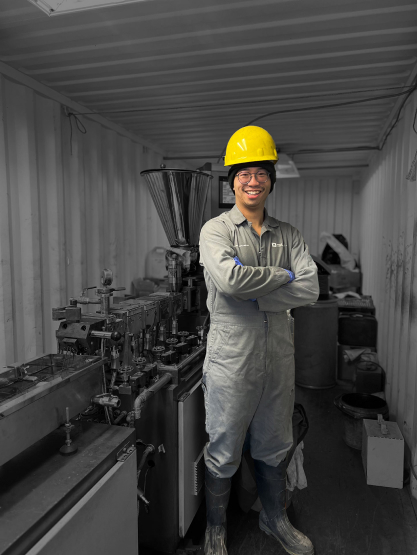
Our CEO, Apoorv Sinha was born in Bihar, India, and grew up in Kuwait. His father worked in the oil and gas sector, giving Apoorv early industry exposure. Encouraged to pursue engineering, he moved to the U.S. to study at Georgia Tech, graduating with a degree in chemical and biomolecular engineering. Afterward, he moved to Calgary, Alberta, to start his career and later founded Carbon Upcycling.
In 2014, Apoorv explored transforming carbon emissions into valuable products, securing grant funding to scale his technology. Accepted into the NRG COSIA Carbon XPRIZE in 2016, he rapidly expanded his team and technology, constructing a reactor processing 20 tonnes per batch by 2020.
Post-XPRIZE, the focus shifted to commercializing the technology, and Carbon Upcycling secured $6.15MM in SEED funding in 2021. By 2022, It Had begun raising a Series A round.

Apoorv's journey started in Calgary at Zerocor Tubulars, where he worked under Greg Boser. Inspired by Emissions Reduction Alberta’s Grand Challenge in 2013, he and Greg developed a mechanochemical process to convert CO₂ into high-performance nanoparticles, winning a $500,000 grant.

This led to further developments and acceptance into the first round of the NRG COSIA Carbon XPRIZE. In early 2016, Apoorv upgraded the prototype reactor to produce 250 grams per batch. He relocated Carbon Upcycling's reactors to a larger facility in Bearspaw, Alberta, increasing capacity and enabling market-specific testing. By summer, the reactor size grew to produce 2 kilograms and then 10 kilograms per batch.
Advancing in the Carbon XPRIZE required proving their claims, so Apoorv designed a reactor capable of producing 3 metric tonnes per batch, a 12,000-fold increase. To build this, he needed a strong team and enlisted Chad Belanger, a journeyman welder and steamfitter.
Rapid scale-up was crucial, and the Carbon XPRIZE grant spurred the company's expansion. Apoorv and Greg realized Carbon Upcycling needed full-time dedication. Apoorv committed fully to the project, ensuring its success.
Carbon Upcycling was a top-10 finalist in the Carbon XPRIZE. This impressive achievement not only brought recognition but also granted an additional $500,000 in funding, enabling the continued scaling of the technology.
By 2019, key hires like Ryan Bourns, Peter Zhou, and Madison Savilow joined the team.

During the HOLCIM Accelerator, the technology was validated for the cement and concrete industry. Carbon Upcycling’s success in the XPRIZE and partnerships with companies like BURNCO highlighted its potential. In 2020, despite COVID-19 setbacks, the team successfully scaled up their reactor, preparing for the final XPRIZE submission.
Post-XPRIZE, the focus shifted to cement and concrete markets, collaborating with BURNCO and securing a SEED round of $6.15MM. By November, Carbon Upcycling secured major contracts with BURNCO/Lafarge Holcim, CEMEX, and Ash Grove, validating their technology’s commercial value and preparing for further growth with a Series A round.
LOREM IPSUM
Under the agreement, the financing is secured by Carbon Upcycling’s assets, and ATEL receives an option to make a future investment in the company.
We will work with Holcim and Amazon to test, validate, and scale our low-carbon supplementary cementitious materials (SCMs) in real-world applications.
Since joining Carbon Upcycling in spring 2025 as Chief Revenue Officer, Markus has led the development of the company’s project pipeline and guided the company as it constructs its flagship commercial project. He succeeds co-founder Apoorv Sinha who assumes the role of President, focusing on investor engagement, external relations, technology development and the advancement of the company’s long-term strategy and direction.
Since joining Carbon Upcycling in spring 2025 as Chief Revenue Officer, Markus has led the development of the company’s project pipeline and guided the company as it constructs its flagship commercial project. He succeeds co-founder Apoorv Sinha who assumes the role of President, focusing on investor engagement, external relations, technology development and the advancement of the company’s long-term strategy and direction.
2026 marks the third year Carbon Upcycling has made the list. The recognition reflects progress made with our partners to advance large-scale projects across North America, starting with our first-of-its-kind project with Ash Grove Cement Company.
The project will use Carbon Upcycling’s patented technology to permanently sequester CO₂ from the cement kiln and utilize it to transform locally produced industrial byproducts into high-quality, low-carbon supplementary cementitious materials (SCMs). Once operational in 2026, the facility will have the capacity to produce up to 30,000 tonnes of SCMs annually, directly contributing to Canada’s climate and clean manufacturing goals.
‘Stamp of approval’: Calgary-based company wins global climate solutions prize. Calgary’s Carbon Upcycling turns industrial waste byproducts into materials for cement production — over the years, it has amassed US$70 million in funding.
The investment round garnered follow-on participation from a strong contingent of existing investors, including Business Development Bank of Canada, Climate Investment, Amplify Capital, and strategic investors CRH Ventures, Oxy Low Carbon Ventures, and TITAN Group. The continued participation of returning investors underscores the growing confidence in Carbon Upcycling’s commercial readiness and role in manufacturing localized, low-carbon building materials.
Carbon Upcycling and TITAN Group have entered into a Memorandum of Agreement (MOA) to explore the commercial deployment of Carbon Upcycling’s technology for producing local, low-carbon building materials.
“Carbon upcycling is a fabulous example of Canadian innovation where they’re taking a waste product from the fossil fuel industry, CO2, and they’re turning it into a product that is absorbed and used in cement,” said Merran Smith, president of New Economy Canada.
We buy steel, cement and energy from international parties instead of prioritizing Canadian interdependence, contradicting not just environmental goals, but economic prosperity and growth for other Canadians. Domestic sourcing can offer significant, tangible benefits for Canadians in every province, and for Canada as a whole.
The question isn’t whether Canada can build data centres — it’s whether we can leverage our resources, talent and vision to build them better. By harnessing our cleantech expertise and commitment to innovation, Canada has what it takes to redefine sustainable data centre construction and set a global benchmark for the 21st century.
Today Elemental Impact, a leading non-profit climate technology investor, announced the 2024 “Build Better Innovation Challenge” winners. In collaboration with Microsoft, Capgemini, and Bouygues, the innovation challenge was designed to fund pilots for companies driving innovations in construction materials and processes.
Carbon Upcycling’s CO2-enhanced mix achieved a 12.5% reduction in cement content while matching the workability of traditional concrete, allowing seamless handling, placement, and setting times for construction crews.
The Calgary-based company recently raised a $34.3 million Series A funding round co-led by BDC Capital’s Climate Tech Fund and Climate Investment to reshape how heavy industry approaches carbon emissions.
Forbes – Carbon Upcycling is one of the companies working through the steps required to develop low-emissions cement.
Juliane brings over 20 years of leadership experience in the energy and infrastructure sectors to Carbon Upcycling. She has held senior roles across both established and growth-oriented energy companies, most recently serving as Director of Western Canada Development at Capstone Infrastructure Corporation and Chief Operating Officer at Genalta Power Inc.
By partnering with international cement producers like CRH and Cemex, Carbon Upcycling is tackling industry-wide challenges and driving sustainability initiatives. These relationships are aimed to develop and implement technologies that significantly reduce carbon emissions in cement production.
This prestigious recognition underscores Carbon Upcycling’s ongoing commitment to meeting rigorous standards of social and environmental performance, transparency, and accountability and deep commitment to being a powerful force for good.
This recognition places us among 100 groundbreaking companies and the only one from Canada chosen for our potential to address the world’s most pressing challenges. Being named a Technology Pioneer is a tremendous honour, reflecting our commitment to innovation and sustainability in carbon capture and utilization.
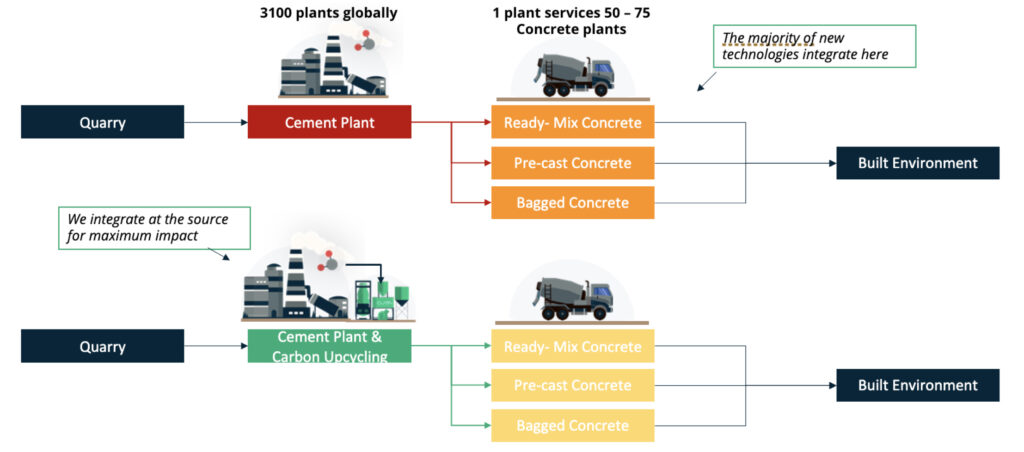
Reduce cement emissions by up to 60% of traditional cement while providing a permanent pathway to sequestering CO2 emissions.

Unlocks a beneficial use for low-grade materials from other industries for use in cement, aligning financial interests with the world’s best interests.

Enhanced materials enable stronger, more resilient concrete to handle our toughest climates.

Low-carbon cement is produced at cost parity using underutilized materials, helping the industry meet growing infrastructure demands.